Here are some cool YouTube videos that fearure polar bears.
GoPro: Polar Bears
Mother Polar Bear and Cubs Emerging from Den
Polar Bears Ice Skating
Polar bears smash the spy cams
Tuesday, November 18, 2014

Saturday, November 8, 2014
Fun Facts!
Here are some interesting fun facts about polar bears.
Polar bear cubs learn to freeze and remain still while their mother hunts. If they move, the mother disciples them, with a whack to the head.
Some female polar bears build dens with multiple rooms and even a ventilation system in the roof.
Polar bear cubs weigh a little more than a pound when they are born.
Polar bears tend to overheat more than to be cold.
A polar bear is so strong, that it can kill an animal with one blow from it's paw
Polar Bears do not hibernate. Female polar bears will den with their young. All polar bears may den for a short time to avoid bad weather.
To read more polar bear fun facts visit
http://www.endangeredpolarbear.com/fun-facts-about-polar-bears.html

Tuesday, November 4, 2014
Polar Bear Live Cams
Do you want to see polar bears in the wild and not leave your house? Then watch the polar bear live cam! There is a website that streams three different live cams. The cams stream from Churchill and can be viewed from 9:30am to 4pm. There are also slide shows full of pictures, fun facts, videos and live streams of African Hippos that you can watch if you get bored of the polar bear live cams.
To view the live cams, click here:
http://explore.org/#live-cams/player/polar-bear-tundra-buggy-cam

To view the live cams, click here:
http://explore.org/#live-cams/player/polar-bear-tundra-buggy-cam
Thursday, October 23, 2014
Polar Bears and Climate Change
Sea ice loss is at an all-time high with the Arctic experiencing
the warmest temperatures in four centuries. The amount of ice lost in 2012
broke all previous records meaning that the ice is melting – and melting fast.
The melting ice has been caused by large amounts of greenhouse gasses in the atmosphere.
Scientists predict that by 2040, the
Arctic will be entirely ice free unless action is taken to reduce greenhouse
gas emissions.
What does this mean for polar bears?
Polar bears rely on the ice to hunt, breed and den. There is
evidence that polar bears are leaving the sea ice to build their dens on land,
even in the winter. In the Western Hudson Bay area, permafrost has declined
meaning that the denning areas are vulnerable to forest fires in the summer. Without
the sea ice, polar bears are unable to hunt for food. Shorter hunting seasons
have made a 22% drop in the polar bear population in the Churchill area. There
has also been a decline in cub survival rates in the last 30 years.
Scientists say that human caused climate change is the
biggest threat to the polar bear populations. Fortunately, they say that there is
still time to save the polar bears if the amount of greenhouse gasses emissions
is significantly reduced by the end of the decade.
To learn more about polar bears and climate change, go to

Wednesday, October 15, 2014
About Polar Bears
So for my second post I decided to post some information on polar bears.
Five countries have polar bear populations: the United States (Alaska), Canada, Russia, Greenland, and Norway. Polar bears live only in Arctic areas that surround the North Pole—not in Antarctica, which surrounds the South Pole. The word arctic comes from the Greek word for bear, and Antarctic comes from the Greek meaning the opposite, without bear.
Polar bears top the food chain in the Arctic, where they primarily prey on ringed seals. Adult male polar bears can weigh from 775 to 1,200 pounds. Females normally weigh 330 to 650 pounds. Females usually give birth to two cubs. Single cubs and triplets can also occur depending on the health and condition of the mother. Cubs stay with their mothers for up to 2-1/2 years, learning how to hunt and survive in the harsh arctic environment.
Biologists estimate there are 20,000 to 25,000 polar bears. About 60% of those live in Canada. In 2008, the polar bears were listed as a threatened species under the Endangered Species Act. The IUNC Polar Bear Specialist Group that of the 19 sub species of polar bears, 4 species are declining, 5 are stable 1 in increasing and 9 have insufficient data.
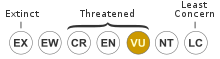
Polar bear's conservation status (vulnerable)
Scientists predict that unless action is taken to stop climate change, we will lose two-thirds of all polar bears by the middle of the century and all of them by the end of the century.
But some people are seeing more polar bears!
Some Native communities in Canada are reporting an increase in the numbers of polar bears on land. Traditional hunters believe this means an increase in population. But some scientists attribute it to polar bears being driven ashore by lack of ice.
To learn more about polar bears go to
http://www.polarbearsinternational.org/about-polar-bears First post
I am doing my blog on polar bears. I chose this topic because I love them and they are my favorite animals. The closest I have ever been to a polar bear was at the zoo last summer. Someday I hope to go and see polar bears in the wild. Follow my blog for more posts about polar bears.

Subscribe to:
Posts (Atom)